Yachting in Croatia: Sailing the Adriatic in Style & Luxury
I remember my first time photographing from a sailing yacht in Croatian waters. Yachting in Croatia: Sailing the Adriatic in Style & Luxury, in , Croatia.
January 6, 2024 · 8 min read
Sailing & yacht photography on the Adriatic
I remember my first time photographing from a sailing yacht in Croatian waters. We’d departed Split’s harbor at dawn, the city still sleeping behind us. As we rounded Marjan Hill into the open Adriatic, the island of Brač appeared in golden morning light across water so blue it looked fake. Camera ready on deck, the boat heeling under fresh breeze, I knew maritime photography would keep me busy for years along this coast.
Croatia’s relationship with the sea runs centuries deep. Dubrovnik once competed with Venice for Adriatic trade dominance. Today the coast is a yacht charter hub drawing vessels from across the world, and the maritime culture is baked into daily life. For photographers that means a constant stream of subjects: superyachts moored in harbors older than most countries, wooden fishing boats at dawn, racing sailboats heeling under full canvas, quiet moments of life aboard vessels working their way along one of Europe’s most varied coastlines.
This guide covers what I’ve learned about photographing sailing, yachts and maritime scenes along Croatia’s Adriatic coast. Shooting from land during harbor scenes, photographing from boats during sailing trips, documenting yacht culture, or telling stories about Croatian maritime heritage, you’ll find technical guidance, location recommendations, timing strategies and creative approaches I’ve refined over several years.
Croatia gives photographers some real advantages for maritime work: over 1,000 islands creating constantly changing coastal scenery, historic harbors where centuries-old architecture meets modern yachting, transparent blue-green Adriatic water that photographs well, and a sailing season from April through October with reliable Mediterranean weather.
Understanding Croatian maritime photography
Croatia’s Adriatic coast divides into several distinct photography regions, each with its own character.
Dalmatia (Split south to Dubrovnik) is the heart of Croatian yachting. Historic walled cities like Dubrovnik, Korčula and Trogir provide dramatic harbor backdrops. Islands like Hvar, Brač and Vis attract luxury yachts. Marinas accommodate everything from modest sailboats to 100-meter superyachts. This is the classic Croatian maritime look: white limestone towns, brilliant blue Adriatic and gleaming yachts.
Istria (Pula, Rovinj, Poreč) feels more intimate. Colorful Venetian-influenced harbors, working fishing boats alongside recreational yachts, a coastal village atmosphere that hasn’t been entirely given over to tourism. Istria’s maritime culture is less polished than peak-season Hvar, which makes it better for documentary work showing actual coastal life.
Kvarner Bay (Rijeka, Opatija, Krk Island) has a different heritage altogether: Austro-Hungarian elegance, working commercial ports and ferry connections to the islands. Less photographed than Dalmatia, but with distinctive perspectives worth the trip.
The islands and archipelagos (Kornati, Elafiti, Pakleni) create wilderness maritime settings: remote anchorages, quiet bays, dramatic karst landscapes rising from turquoise water, most accessible only by boat.
Maritime photography seasons
Summer (June through August) brings peak yachting activity. Maximum luxury yacht presence, especially around Hvar and Dubrovnik. All marinas operating full services. Sailing regattas and events throughout. Longest days, with sunset after 8:30 PM. But also maximum crowds, highest prices and harsh midday light that flattens everything.
Shoulder season (May, September, October) is when I prefer to shoot. The light quality is beautiful, there are fewer tourists, temperatures are moderate, yachting activity is still substantial, and charter costs drop. The trade-off: fewer superyachts than peak summer.
Spring (April-May) brings regattas starting up, yachts arriving for the season, dramatic weather creating interesting skies, and wildflowers on the islands. Some services are still closed and the water is cold for swimming, but the photography conditions are strong.
Autumn (September-October) gives you warm water, low-angle light, autumn colors on coastal vegetation, and the season’s most stable weather.
Winter (November-March) sees almost no tourist yachting, but the local maritime life continues: fishing boats heading out, local sailors, commercial vessels, and dramatic winter light and storms. Most facilities close and conditions can be rough, but the genuine material is there if you’re willing to deal with the cold.
Camera settings and technical approaches
Harbor and marina photography
Photographing stationary yachts in marinas is a different discipline than shooting sailing action.
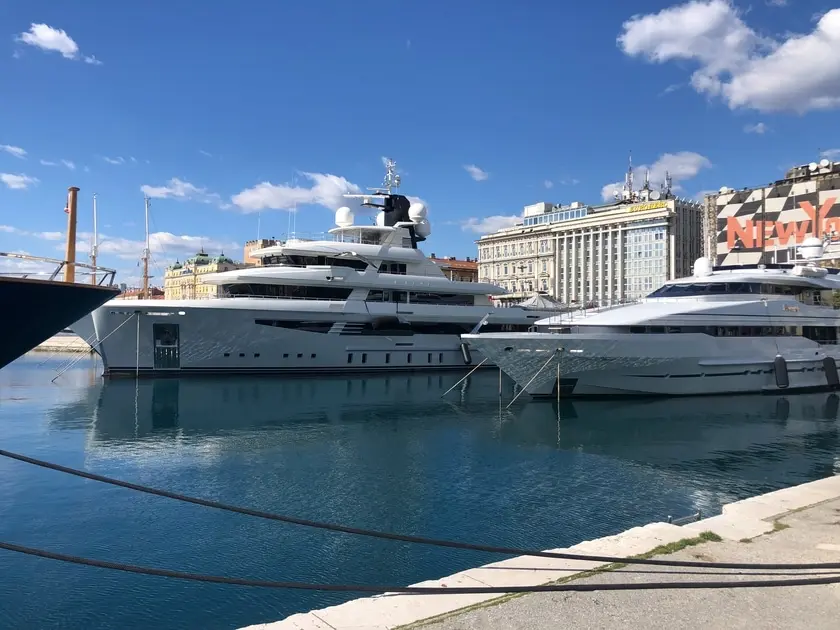
For stationary harbor work I use Aperture Priority mode, f/8 to f/11, ISO 100-200 for clean files. A polarizing filter is non-negotiable for yacht photography: it cuts glare on hulls and water, deepens the blue of sky and sea and gives you that clean white-yacht-against-blue-Adriatic look. I shoot mostly during golden hour or blue hour with a tripod.
Calm morning or evening water creates mirror-image reflections of yachts. These are spectacular when properly exposed, but you need protected harbors with minimal boat traffic churning up the surface.
Including Croatian architectural elements in your frames matters more than you’d think. Medieval walls and colorful towns, with coastal mountains in the background, turn a boat photo into a place photo. Without that context you’re left with isolated yacht portraits that could have been shot anywhere.
Luxury yacht details communicate lifestyle in ways that wide shots can’t: polished teak decks, gleaming hardware, tender boats, the deck furniture. Get close and fill the frame with texture.
Sailing action photography
Photographing boats under sail demands fast shutter speeds and good timing.
I switch to Shutter Priority or Manual mode, 1/500s to 1/1000s minimum, f/5.6 to f/8, ISO 400-800 (higher if the light demands it for speed). Continuous AF with tracking, burst mode at 6-10 fps.
The moments that matter: boats heeling dramatically, spray flying from bows, colorful spinnakers deploying, boats rounding marks during races. If you’re shooting racing, the mark roundings are where the action concentrates.
Panning is a technique worth practicing. Track moving boats with your camera while using slower shutter speeds (1/60s to 1/250s) to create motion blur in the background while keeping the boat sharp. It takes practice but the results look far more dynamic than frozen frames.
Telephoto compression with a 70-200mm or longer lens brings Croatian coastal mountains or islands visually closer to the sailing yachts, creating layered compositions that give a sense of place.
Photographing from boats
Shooting while you’re on a moving vessel is its own challenge.
Push shutter speeds to 1/1000s or faster to compensate for the boat’s movement. Enable image stabilization. Shoot in burst mode to improve your odds of getting sharp frames between wave motions. Expect to use ISO 400-1600 even in bright light because of the speed requirements.
Brace yourself against solid parts of the boat. Shoot between wave motions. Protect your gear from saltwater spray, which will find its way onto everything no matter how careful you are. Wide-angle lenses give immersive deck perspectives, and including boat elements like rigging, rails and sails in the foreground adds depth.
Croatian harbors and marinas
Hvar Town
Hvar Town harbor is Croatian yachting at its most glamorous: superyachts moored against Venetian architecture, with an active waterfront nightlife scene.
I shoot early morning (6:00-7:00 AM) before the yacht passengers and party crowd wake up, or in the evening (8:00-10:00 PM) when the harbor comes alive. The Fortica fortress above town gives elevated perspectives of the yacht-filled harbor below. Blue hour is when illuminated yachts create the strongest images.
Dubrovnik Old Port
Ancient fortifications rising from the harbor where yachts moor. This is Croatia’s most dramatic yacht photography setting.
The city walls give you elevated harbor views. Harbor-level shots from the breakwaters at sunset. Including Lovrijenac Fortress in compositions adds the medieval weight. Early morning before cruise ships arrive gives you an empty harbor with soft light.
Rovinj
Colorful fishing boats and yachts against Venetian houses and St. Euphemia’s bell tower. This is Istria’s most photogenic harbor by a comfortable margin.
Sunset from the waterfront promenade is the iconic shot, and for good reason: the harbor faces west and the evening light is extraordinary. Early morning brings the fishermen and genuine working-harbor activity. The mix of working boats and recreational yachts gives you images that feel lived-in rather than staged.
Post-processing maritime photography
My typical workflow for yacht and sailing images starts with the basics: enhancing the Adriatic’s blue-green water colors, boosting vibrance for yacht flags and hardware details, darkening skies slightly to keep the boat as the clear subject, and lifting shadows in harbors without flattening the mood.
Color grading tends toward enhancing blues (the Adriatic’s signature), warming tones in golden hour shots, and adding cyan-blue split toning for evening harbor scenes.
I apply heavier sharpening to stationary yacht detail shots than to sailing action, where motion already creates visual interest.
Maritime photography converts well to black and white. Stripping color emphasizes form, texture, weather and mood. I find it works particularly well for sailing action and scenes with dramatic weather, where the light is doing the heavy lifting anyway.
Croatia’s maritime photographic richness
After years photographing yachts, sailing and maritime culture along this coast, I’m still finding new angles. The Hvar superyacht scene, the Istrian fishing villages, the regatta action, the dawn harbors empty and still, each asks something different from you as a photographer.
The technical challenges are real: managing harsh Mediterranean light, protecting gear from saltwater, and capturing action from moving boats without ruining frames. But they’re solvable with the techniques and equipment covered here. The payoff is a body of work from one of the most photographable coastlines anywhere.
Shooting harbor scenes from land, joining sailing trips to work from deck, documenting yacht culture, digging into Croatia’s long relationship with the sea. This coast has more to offer than you’ll exhaust in a single trip. Or several.
💙 Support My Photography Work If this guide helps you capture beautiful maritime imagery along Croatia’s Adriatic coast, please consider supporting my work on Patreon. Your support enables me to continue creating detailed photography guides and exploring Croatia’s maritime beauty. Thank you! 🙏📸
Explore More Croatian Photography Guides:
- Croatia Photography Complete Guide - Ultimate regional overview
- Sailing the Adriatic Guide - Complete sailing photography guide
- Dubrovnik Photography - Historic harbor and city photography
- Rovinj Photography - Istrian coastal town guide
Contact me!